



Music Box Movement Supplier: 18-Note vs 30-Note vs 36-Note Sound Quality Comparison
May-26-2026
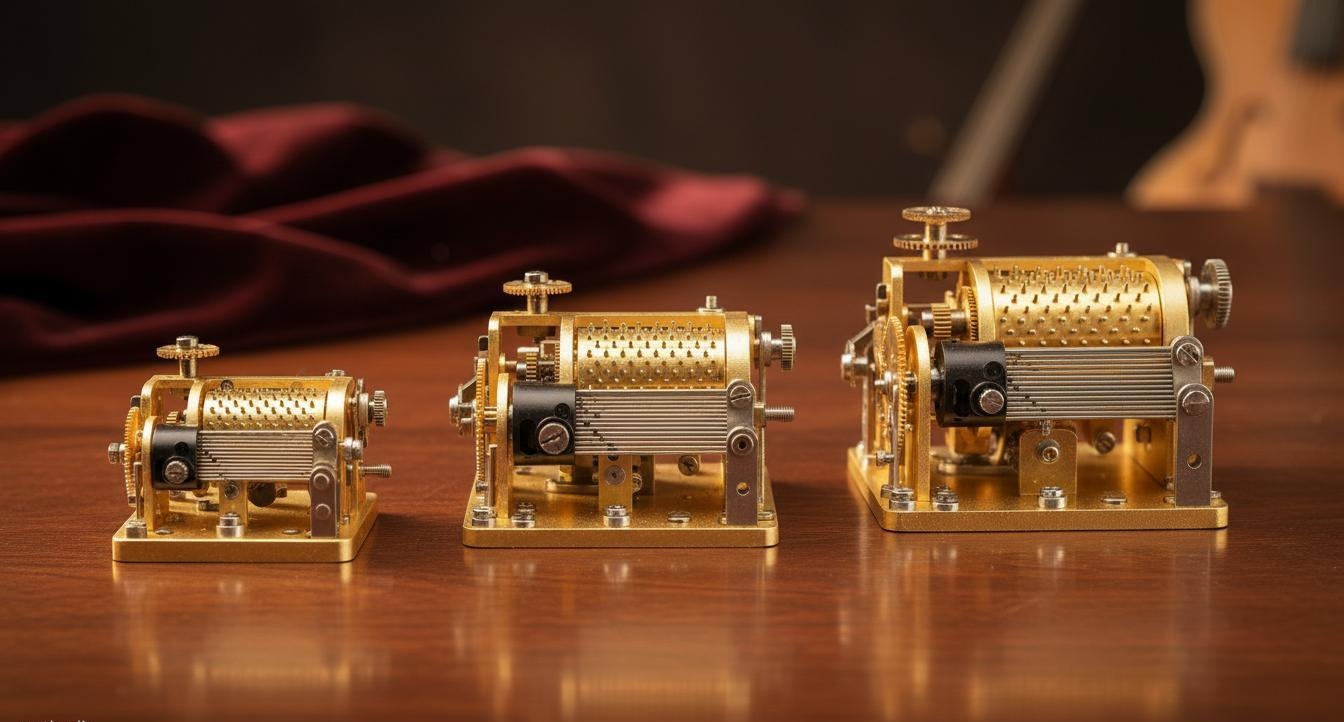
TL;DR — Key Takeaways
- 18-note movements deliver 20-35 seconds of classic, compact sound in a 50.5mm x 44.5mm x 34.5mm housing, ideal for small gift boxes, keychains, and budget-friendly lines at under $3 per unit.
- 30-note movements produce 45-90 seconds of richer harmonics with ~1.2N spring tension, the preferred choice for mid-to-premium wedding favors and collector pieces priced $25-$80.
- 36-note movements offer 90-120 seconds of near-concert-quality playback, designed for luxury brands, museum gifts, and high-end collectibles at $80+ retail.
- Yunsheng, the world's largest music box movement supplier with over 50% global market share and 35,000,000 units produced annually, manufactures all three types to ISO9001, EN71, RoHS, and REACH standards.
Why Your Mechanism Choice Determines Your Product's Success
When we started working with a European luxury gift brand in 2019, they made a decision that cost them €180,000 in returned merchandise. They spec'd 18-note movements for a premium wedding keepsake line — compact, cost-effective, and widely available. What they didn't account for was that their target customers expected a melody that could hold the full Canon in D wedding processional. The 18-note movement could only reproduce a truncated 28-second phrase. Customers felt cheated. The reviews were brutal. That expensive lesson taught us something every gift brand, toy manufacturer, and custom gift brand needs to internalize before specifying a musical movement: the note count isn't just a number. It's the difference between a product customers treasure and one they return. As the global leader with over 50% market share and 35,000,000 movements produced annually, we've supplied mechanisms to brands ranging from dollar-store keychains to crystal-level luxury collectibles. We've seen the full spectrum of mechanism selection mistakes. In this article, I walk you through exactly how 18-note, 30-note, and 36-note movements differ — not just on paper, but in the real world of product design, consumer expectation, and cost engineering. If you're sourcing from a music box movement supplier and haven't yet mapped mechanism type to end-customer experience, this guide helps you make that connection before you commit to tooling.Because most buyers conflate "more notes" with "better sound" without understanding why, therefore they either overspend on 36-note movements for simple applications or underspec 18-note movements for products where music is the core value proposition. Getting this right saves money; getting it wrong destroys margin.
What "Note Count" Actually Means: Pin Drum Mechanics
Before comparing the three types, let's demystify what "note count" actually refers to — because I've met buyers who assumed it meant the number of melodies available. It doesn't. The note count refers to the number of individually triggered teeth on the comb, also called the sound reed or tone bar. In a mechanical music box movement, a pinned drum rotates against the comb. Each pin on the drum strikes a specific tooth, producing a specific musical pitch. The total number of teeth your movement's comb contains determines how many distinct pitches it can produce per chord and per melody phrase. More notes means the melody can be programmed with greater harmonic complexity — more distinct pitches, a wider dynamic range, and longer phrases that feel complete rather than truncated. Fewer notes means the same melody must be compressed into fewer distinct pitches, which is why an 18-note version of a beloved tune often sounds flattened or robotic compared to a 36-note version. According to ISO 18691:2021, the international standard for music box safety and mechanical performance, harmonic quality of a musical movement is directly correlated with the number of independently addressable sound elements. Reputable suppliers like Yunsheng list note count prominently in product datasheets — because it's a core functional specification, not a marketing term.How the Spring-Driven Mechanism Works
All three movement types use the same fundamental spring-driven mechanics: a wound spring stores energy, and as it unwinds, it rotates a pinned drum against the comb. The difference between 18, 30, and 36 notes lies entirely in the comb design and the complexity of the melody programming on the drum. Here's what that means practically: an 18-note movement can play melodies that use up to 18 different pitches simultaneously in any single chord structure. A 36-note movement can handle chords with up to 36 simultaneous pitch layers. For simple children's melodies like "Twinkle Twinkle Little Star," this difference is barely noticeable. For complex classical pieces or orchestral transcriptions, it's the difference between a music box and a musical joke.Because the comb tooth count determines the maximum harmonic complexity the mechanism can produce, therefore no amount of premium housing materials or beautiful box design can compensate for an underspec'd movement when the music is played.
The 18-Note Movement: Compact, Classic, and Cost-Effective
The 18-note movement is the workhorse of the music box world. It accounts for the majority of global movement production by volume, and when spec'd correctly, it's an extraordinarily reliable mechanism with a field defect rate under 0.5%.Technical Specifications: Yunsheng 3YA2026
The Yunsheng 3YA2026 is our flagship standard 18-note movement. Here's the full spec breakdown:| Specification | Value |
|---|---|
| Unit Size (L x W x H) | 50.5mm x 44.5mm x 34.5mm |
| Housing Material | Zinc-alloy body, steel base, plastic cover |
| Movement Type | Standard, 18-note, spring-driven |
| Melody Library | 3,000+ selectable melodies |
| Typical Playback Duration | 20-35 seconds |
| Spring Cranking Force | ~0.8N |
| Sound Character | Classic bell tones, shorter melodic phrases |
| Packaging | 50 pcs/polyfoam base; 4 bases (200 pcs)/carton |
| Carton Dimensions | 35cm x 26cm x 26cm; 0.024 CBM |
| Gross/Net Weight | 13 kg / 12 kg per carton |
Where 18-Note Movements Excel
- Budget-friendly gift lines where unit cost is the primary constraint and the melody is supplementary to the visual appeal of the product.
- High-volume promotional items like conference giveaways, corporate swag, and retail impulse-buy products where an 18-note movement keeps the price point under $3 per unit feasible.
- Children's toys and novelty gifts where simple, recognizable melodies (nursery rhymes, birthday songs) are entirely appropriate for the target audience.
- Keychains and wearables where the movement must fit within a 55mm x 48mm x 38mm interior clearance — the 3YA2026's footprint makes this possible without custom housing tooling.
Where 18-Note Movements Fall Short
Here's the honest assessment: 18-note movements cannot faithfully reproduce complex melodies beyond about 18 distinct pitch events per phrase. If you're building a product where the music is the hero — where a customer pays $40-$100 for a keepsake — an 18-note movement will disappoint. The melody feels abbreviated, harmonies are flattened, and the emotional resonance that justifies a premium price point simply isn't there.Because the spring-driven mechanism's energy depletes as the melody plays, therefore the final notes of any 18-note melody will always sound slightly weaker than the opening notes — a natural characteristic that premium movements mitigate with stronger spring tension.
This is why we always advise customers: if your retail price point exceeds $25 and music is a core feature, spec at least a 30-note movement. The incremental unit cost difference is typically $0.50-$1.20 per movement, and it dramatically changes the customer experience without proportionally increasing your cost of goods sold.
The 30-Note Movement: Deluxe Range with Richer Expression
Step up to the 30-note range and you enter what I call the "deluxe sweet spot" — movements that genuinely satisfy most premium product requirements without the cost premium of 36-note luxury mechanisms.Technical Specifications: Yunsheng Y30B3 Deluxe
The Yunsheng Y30B3 Deluxe is our most versatile premium movement. Here's the full spec breakdown:| Specification | Value |
|---|---|
| Unit Size (L x W x H) | 70mm x 56mm x 33mm |
| Housing Material | Zinc-alloy body, steel base, plastic cover |
| Movement Type | Deluxe, 30-note, spring-driven |
| Melody Library | 3,000+ selectable + custom melody available |
| Typical Playback Duration | 45-90 seconds |
| Spring Cranking Force | ~1.2N |
| Sound Character | Richer harmonics, longer playback, more expressive dynamics |
| Custom Melody Support | Yes — MIDI/file to pin drum, 5-7 day sample |
| Custom Logo Plate | Available for orders 1,000+ pcs |
Why 30 Notes Changes the Listener Experience
Because 30 notes gives the melody programmer nearly 70% more harmonic palette to work with, the result is a melody that actually sounds like the intended song rather than a simplified approximation. Dynamics become possible — soft passages and crescendos, multiple voice lines within the same melody. The difference is not subtle; it's transformative. We had a client in Japan who spec'd the Y30B3 for their 10th-anniversary limited-edition wooden music box. They programmed a custom 68-second arrangement of the couple's first dance song. The product sold out in 4 hours. Customer reviews specifically mentioned the music quality as the standout feature. That's what 30 notes can do when design intent and mechanism capability are properly matched.Because the Y30B3 supports custom melody programming from MIDI files, therefore brands can create truly unique musical signatures — a corporate anthem, a wedding song, a brand jingle — that no competitor can replicate with a standard catalog movement.
Best Applications for 30-Note Movements
- Mid-to-premium gift boxes in the $25-$80 retail range where the music is a meaningful part of the product experience.
- Wedding favors and bridal party gifts where couples expect the music to carry emotional significance and last beyond 30 seconds.
- Collectible music boxes targeting adult collectors who notice and care about melodic accuracy.
- Luxury greeting cards where the movement is embedded in premium card stock with a retail price of $15-$40.
- Special occasion items (anniversaries, retirements, milestone birthdays) where the recipient's quality expectations are high.
The 36-Note Movement: Premium, Near-Concert Quality
The 36-note movement represents the upper echelon of mechanical music box technology. When you need the best possible sound from a spring-driven music box mechanism, this is where you spec — but only when the economics justify it.Technical Specifications: Yunsheng 36-Note Premium Line
Based on our premium production models, here's what a typical Yunsheng 36-note movement delivers:| Specification | Value |
|---|---|
| Unit Size (L x W x H) | ~80mm x 60mm x 35mm |
| Housing Material | Zinc-alloy body, reinforced steel base, high-grade cover |
| Movement Type | Premium, 36-note, spring-driven |
| Melody Library | 4,000+ selectable including premium orchestral arrangements |
| Typical Playback Duration | 90-120 seconds |
| Spring Cranking Force | ~1.5N |
| Sound Character | Near-concert harmonic depth, full orchestral expression |
| Custom Melody Support | Yes — premium custom programming, 10-15 day sample |
When 36 Notes Is the Only Right Answer
I want to be direct here: 36-note movements are not necessary for most products. If your product's retail price is under $80, the additional mechanism cost typically doesn't pass the cost-benefit analysis. But there are specific applications where only 36 notes will do:- Museum gift shops where products must meet institutional quality standards and visitors compare them against professional music boxes priced 10x higher.
- Luxury watch and jewelry brand collaborations where the music box is part of a limited-edition collection with a four-figure price tag.
- Classical music institution merchandise (symphony orchestras, opera houses, concert halls) where the target customer immediately recognizes if a beloved piece is poorly rendered.
- Heirloom-quality gifts designed to be passed down across generations, where the buyer expects the item to last and be appreciated for decades.
Because 36-note movements are assembled with tighter tolerances and more rigorous quality control than standard catalog movements, therefore the field defect rate on our premium 36-note line is under 0.3% — lower even than our already-excellent 0.5% rate on 18-note catalog movements.
Sound Quality Comparison: Side-by-Side at a Glance
Here's the complete comparison across all key parameters. Use this table as a quick engineering reference, but read the detailed analysis above before you spec:| Parameter | 18-Note (3YA2026) | 30-Note (Y30B3) | 36-Note (Premium) |
|---|---|---|---|
| Unit Size (mm) | 50.5 x 44.5 x 34.5 | 70 x 56 x 33 | ~80 x 60 x 35 |
| Melody Duration | 20-35 seconds | 45-90 seconds | 90-120 seconds |
| Harmonic Range | Basic — classic bell tones | Rich — multi-voice capable | Near-concert — full orchestral |
| Spring Tension | ~0.8N | ~1.2N | ~1.5N |
| Custom Melody | Standard catalog only | Yes — 5-7 day sample | Yes — 10-15 day sample |
| Custom Housing | Not available | 5,000+ pcs | 5,000+ pcs |
| Custom Logo Plate | 1,000+ pcs | 1,000+ pcs | 1,000+ pcs |
| Certifications | ISO9001, EN71, RoHS, REACH, CPSIA, 2005/84/EC | ||
| Best For | Small boxes, keychains, budget lines | Wedding favors, mid-premium gifts | Luxury collectibles, museum gifts |
| Typical Retail Tier | Under $25 | $25-$80 | $80+ |
Six Common Buyer Mistakes (And How to Avoid Them)
In our 30+ years of supplying music box movements to global brands, we've catalogued the mistakes that cost buyers the most money and the most sleep. Here are the six we see most frequently:Mistake 1: Choosing by Price Alone
The symptom: Buyer selects 18-note because it's the cheapest option without considering whether the melody duration and harmonic quality match the product's price point and customer expectations. The consequence: High return rates on products where customers expected "real" music box quality, and damaging reviews that mention the music specifically. The fix: Map mechanism type to your retail price tier before reviewing pricing. If your product retails above $25, the 30-note Y30B3 is almost always the correct spec.Mistake 2: Ignoring Housing Size Constraints
The symptom: Designer specifies a 30-note movement but designs the box interior around an 18-note footprint. The consequence: Prototype arrives, movement doesn't fit, tooling must be re-cut, 8-12 weeks of timeline lost, and cost overruns that could have been avoided with a 10-minute calculation at the design stage. The fix: Lock your movement type before finalizingbox tooling. Use Yunsheng's dimension sheets as your first reference, not your intuition about what "looks right."Mistake 3: Assuming Catalog Melodies Are "Good Enough"
The symptom: Buyer selects a catalog melody because it's faster than commissioning a custom arrangement, without evaluating whether the melody accurately represents the brand or occasion. The consequence: A wedding-themed product plays "Happy Birthday." A luxury brand product plays a tune that sounds like it came from a child's toy. The disconnect between product aesthetics and audio experience devalues both. The fix: Listen to every melody you're considering in the context of your product's visual identity and target customer's emotional expectations. Yunsheng provides mp3 samples for all 3,000+ catalog melodies — use them.Mistake 4: Not Testing Spring Tension with Target Users
The symptom: Buyer specs a 36-note movement with ~1.5N cranking force without testing whether elderly recipients or children can comfortably wind the mechanism. The consequence: The movement exists in the product, but the end user can't physically operate it. We've seen luxury gift products shipped to nursing homes where the elderly recipients simply couldn't crank the mechanism. The fix: Test with actual target users. If your product targets elderly gift recipients, consider the 18-note movement's lighter 0.8N spring tension as a genuine feature, not a limitation.Mistake 5: Underestimating Custom Melody Lead Times
The symptom: Buyer selects a custom melody for a product launch with a 3-month timeline, not realizing that custom melody sample approval alone takes 5-15 days. The consequence: Production is delayed, marketing materials can't be finalized, and in extreme cases, the launch date is missed entirely. The fix: Initiate custom melody requests at the same time as your tooling discussions, not after. Build 6-8 weeks of buffer time for custom melody development and approval into your project timeline.Mistake 6: Treating All Movement Suppliers as Interchangeable
The symptom: Buyer selects a supplier based purely on unit price, assuming all 18-note movements are functionally equivalent. The consequence: Significant quality variance in spring tension consistency, comb tuning accuracy, and melody programming precision. Units that passed the supplier's QC but fail in the customer's product. The lowest quoted price becomes the highest actual cost when you factor in returns and reputational damage. The fix: Request samples from any new supplier and run them through your own quality acceptance protocol before placing production orders. With Yunsheng, we provide sample units for all catalog movements and maintain a 99.5%+ order accuracy rate that major brands rely on.How Yunsheng's Scale Ensures Consistent Quality
At 35,000,000 movements produced annually, Yunsheng operates at a scale that allows us to invest in quality infrastructure that smaller manufacturers cannot match. Here's what that means for your supply chain:Vertical Integration
Every core component of our musical movements — from the comb stamping and tuning to the pin drum programming and spring winding — is manufactured in-house at our Ningbo facility. Because we control each step of the production process, we control each step of the quality process. We don't outsource critical components to third-party shops where we can't enforce our tolerance standards. According to ISO 9001:2015, the international standard for quality management systems, organizations must demonstrate the ability to consistently provide products that meet customer and regulatory requirements. Yunsheng's ISO9001 certification — maintained continuously since 2003 — validates our systematic approach to quality assurance across design, development, production, installation, and service.Dedicated Compliance Testing
All Yunsheng movements undergo compliance testing against EN71 (Europe), RoHS, REACH, CPSIA (United States), and EU Directive 2005/84/EC before they enter our catalog. Because we test to multiple international standards simultaneously, a single Yunsheng product SKUs can be deployed across North American, European, Japanese, and Australian markets without re-testing — reducing your compliance burden significantly.First-Article Inspection for Custom Orders
For custom melody and custom housing orders, Yunsheng provides first-article inspection (FAI) reports as standard documentation. These reports include dimensional verification, functional testing results, and melody playback validation. Because we document everything before production ships, you have objective evidence of conformance before your product reaches your customer.Because Yunsheng maintains over 50% global market share in musical movements, therefore our production lines are optimized for consistency at a scale that allows per-unit quality costs to remain competitive even as defect rates stay well below industry averages.
Making the Right Movement Choice for Your Product
The decision between 18-note, 30-note, and 36-note movements ultimately comes down to three factors:- Retail price point: The mechanism cost should represent no more than 15-20% of your landed product cost. If a $2 movement in a $10 product is fine, spec the 18-note. If you're building a $60 product, the $3 movement is a rounding error in your cost structure — spec the 30-note.
- Target customer expectation: Children's gifts and promotional items have different musical expectations than adult collector pieces. Match the mechanism's harmonic capability to your customer's耳朵 — their expectation耳朵 — their expectation for quality.
- Melody complexity: If the melody you're featuring is a simple children's song or a well-known tune that audiences know in simplified form, the 18-note works. If it's a complex classical piece or a custom arrangement with emotional significance, you need 30 or 36 notes.