



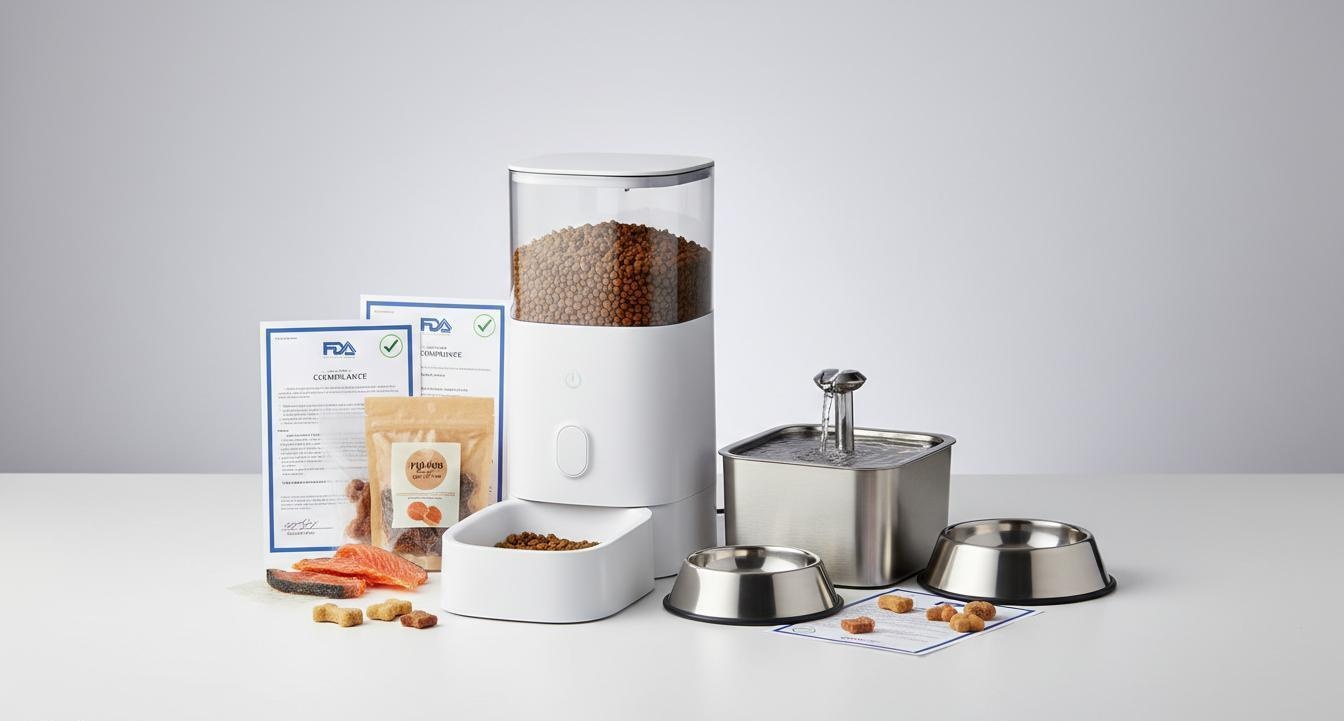
Why US Pet Retail Distributors Are Sourcing Pet Supplies Wholesale from China — and Why Compliance Is Non-Negotiable
The numbers tell a compelling story. The US pet industry surpassed $150 billion in revenue in 2024, with pet food and supplies representing the single largest spending category at over $50 billion annually, according to the American Pet Products Association (APPA). For US pet store distributors seeking competitive pricing on high-volume SKUs — automatic feeders, water fountains, crates, chew toys, and travel gear — sourcing pet supplies wholesale from China has become the dominant procurement strategy. But here is what separates the distributors who scale profitably from those who face costly recalls, customs holds, or lawsuits: compliance is not optional. Importing non-compliant pet products into the United States exposes distributors to enforcement actions from the FDA, the Consumer Product Safety Commission (CPSC), and state authorities — particularly in California. Each year, containers are seized at US ports because documentation was missing, test reports were fabricated, or the supplier simply did not understand the regulatory requirements. As someone who has spent 30 years vetting factories across Zhejiang and Guangdong for CBNB Supplier’s network of 36,000+ cooperative manufacturers, I have seen what separates a legitimate compliance program from a paperwork exercise. This guide gives you the complete checklist — no fluff, no lawyerspeak — so you can import with confidence.FDA Compliance: Food-Grade Materials and Food Contact Regulations
How the FDA Classifies Pet Feeders
The US Food and Drug Administration regulates pet food bowls, feeders, and waterers under its food contact article framework. FDA requires ABS material to be food-grade certified because the feeder is classified as a food contact article. Therefore, importers must ensure that the ABS plastic used in the product body, food chamber, and any component that contacts pet food has been evaluated for food safety under the Federal Food, Drug, and Cosmetic Act.FDA food contact regulations (21 CFR Parts 174–186) require that all polymer materials in food contact applications be manufactured under Good Manufacturing Practice (GMP) conditions because the agency recognizes that material composition directly affects food safety. Therefore, your supplier must provide an FDA food-grade compliance declaration for the ABS resin, covering extractives limits, color additives, and residual monomers.
What Distributors Must Demand from Their Supplier
When evaluating a Chinese supplier for smart pet feeders or any product that contacts food, you need the following documentation:- FDA food-grade material declaration — the resin supplier’s own FDA acknowledgment letter for the specific ABS grade used
- 21 CFR compliance statement — confirming no restricted use of colorants, plasticizers, or monomers above FDA limits
- GMP documentation — evidence that the factory follows Good Manufacturing Practice during production, including batch traceability records
- Extractives/leachables test report — from an accredited lab, simulating food contact conditions with food simulants (water, acid, alcohol)
⚠ Port of Entry Reality Check
FDA does not pre-approve pet products. However, if FDA inspectors examine your shipment at the port and find non-compliant ABS materials, they can issue an Import Alert (Red Flag) that applies to all future shipments from that supplier — not just yours. In 2023, FDA issued Import Alerts affecting over 340 product lines from Southeast Asian and Chinese manufacturers for food contact violations. One bad shipment can blacklist a supplier for years and leave you liable for all costs of disposal or re-export.
CPSIA Compliance: Lead, Phthalates, Tracking Labels, and Third-Party Testing
The Consumer Product Safety Improvement Act (CPSIA) of 2008 — administered by the CPSC — applies to virtually all consumer products intended for household use, including pet supplies. CPSIA mandates lead content limits of 100 ppm for surface coatings and 300 ppm for substrates because lead exposure in pets and humans occurs through skin contact, mouthing, and ingestion. Therefore, any plastic component in a pet feeder — even if it does not directly contact food — must meet these stringent thresholds.Lead and Phthalate Limits: The Numbers That Matter
| Hazardous Substance | CPSIA Limit | California Prop 65 | Testing Required |
|---|---|---|---|
| Lead – surface coatings | 100 ppm | 0.5 ug/day (oral) | Third-party lab (CPSC-accepted) |
| Lead – substrates | 300 ppm | 0.5 ug/day (oral) | Third-party lab (CPSC-accepted) |
| DEHP, BBP, DBP, DnHP | 0.1% each (1000 ppm) | No Safe Harbor | Third-party lab (CPSC-accepted) |
| DINP, DIDP | 0.1% (intentionally added) | Prop 65 listed | Third-party lab recommended |
Pet store distributors bear primary legal responsibility for CPSIA compliance because the law holds the importer of record responsible for ensuring products meet lead and phthalate limits at the time of manufacture. Therefore, waiting until products arrive at a US warehouse to discover non-compliance is far too late — the financial exposure ($100,000+ for a CPSC enforcement action) far exceeds the cost of pre-import testing from a CPSC-accepted laboratory.
Tracking Labels and Traceability
Every consumer product imported into the US must carry a tracking label under CPSIA Section 103. This is not optional, and it is one of the most commonly overlooked requirements by new importers. Your tracking label must include:- Name of the manufacturer (or private labeler) — including city and country of manufacture
- Manufacturing date (at minimum month and year; day preferred)
- Batch or lot number sufficient to identify the production run
- Country of origin: “Made in China”
Third-Party Laboratory Testing
Third-party laboratory testing by a CPSC-accepted lab is mandatory for children’s products and strongly recommended for pet supplies to demonstrate due diligence because it provides an independent, verifiable compliance record that the CPSC, FDA, and plaintiffs’ attorneys will scrutinize during any investigation. For smart pet feeders, plan for the following tests:- 16 CFR Part 1303 — lead in paint/surface coatings (ASTM F963 method)
- 16 CFR Part 1307 / CPSIA Section 108 — phthalates in plastic components
- ASTM F963 — physical and mechanical hazards (small parts, sharp edges, projected parts) — especially relevant for feeders with removable components that pets could ingest
- FCC Part 15B — electromagnetic emissions (for WiFi/Bluetooth smart feeders; see Section 4)
FCC Compliance: Why Your Smart Pet Feeder Needs More Than a CE Mark
Smart pet feeders with WiFi (802.11b/g/n) or Bluetooth modules are classified as intentional radiators under FCC rules. FCC Part 15B under 47 CFR limits electromagnetic radiation to prevent interference with other devices because the FCC has a mandate to manage the radio frequency spectrum and prevent harmful interference across all devices operating within US jurisdiction. Therefore, every WiFi or Bluetooth-enabled pet feeder imported into the US must be tested for radiated and conducted emissions before it can legally be sold.Smart pet feeders with WiFi or Bluetooth modules must be FCC certified before US market entry because importing uncertified intentional radiators violates Section 302 of the Communications Act. The penalty for non-compliance can include seizure of goods, fines up to $50,000 per violation, and injunctions. Unlike FDA rules, FCC enforcement is immediate — US Customs has automated screening that flags uncertified electronics at the border.
The two pathways for FCC compliance are:
- FCC Certification (for intentional radiators like WiFi/Bluetooth) — requires testing by an FCC-recognized Television Equipment Testing Laboratory (TCT) and issuance of an FCC ID
- Supplier’s Declaration of Conformity (SDoC) — for some unintentional radiators; the supplier attests to compliance but testing by an accredited lab is still required
California Prop 65: The State Regulation That Bites Distributors Nationwide
California’s Proposition 65 (Safe Drinking Water and Toxic Enforcement Act of 1986) operates differently from federal regulations — it is a state “right-to-know” law with teeth. California Prop 65 applies to any pet product sold in California because the law requires businesses to provide clear and reasonable warnings before exposing consumers — or their pets — to listed chemicals. Distributors who sell to CA customers are responsible for Prop 65 compliance regardless of where the product was manufactured. Penalties are $2,500 per violation per day, making compliance essential for distributors of any size. A single product line sold for 90 days in California without required Prop 65 warnings could generate $225,000 in penalties — before attorneys’ fees. Critically, private citizens and competitor law firms frequently bring Prop 65 enforcement actions, making it one of the most litigated consumer protection statutes in the US.Prop 65 requires Prop 65-compliant warning labels on all affected pet supplies sold in California because listed chemicals including lead, phthalates, cadmium, and formaldehyde are known to cause cancer, birth defects, or reproductive harm. Therefore, distributors must ensure their Chinese supplier applies the correct Prop 65 warning statement on the product label or inner packaging before products enter California distribution channels. The statement must name each listed chemical, not use generic language.
The most practical approach for wholesale importers is to build Prop 65 compliance into the product specification from the outset. Since CBNB Supplier’s full product catalog includes compliant documentation packages, working with a supplier that has pre-tested against Prop 65 chemical thresholds is far more cost-effective than retro-labeling or defending a violation.
CBNB Supplier’s Compliance Advantage: 36,000+ Factories with Pre-Verified Documentation
When I started building CBNB Supplier’s factory network 30 years ago, the biggest complaint from American buyers was not price — it was documentation reliability. They had test reports that turned out to be forged, certificates that did not match the actual product, and no recourse when a shipment was held at customs. That experience shaped how we built our compliance verification system. CBNB Supplier pre-verifies all compliance documentation before it reaches the buyer because we believe compliance documentation is a product feature, not an afterthought. Every factory in our network that supplies pet products undergoes a multi-step verification process before we recommend them to distributors. We do not just collect certificates — we audit the underlying test data, verify lab accreditation, and cross-reference batch numbers against production records. Our compliance package for pet product orders includes:- Factory GMP audit report — third-party verified, renewed annually
- Full CPSIA test reports from CPSC-accepted third-party laboratories (not just certificates)
- FDA food-grade material declarations traceable to the specific ABS resin lot used in production
- FCC test reports and FCC ID for all smart electronics, verified against the FCC database
- Prop 65 screening reports covering all listed chemicals — so you know exactly which warning language applies
- Batch-level traceability from raw material to finished product, supporting precise recall management if ever needed
Working with a pre-verified supplier network reduces compliance risk to near-zero because every factory in CBNB Supplier’s network has already been through our multi-step verification process, including lab credential audits and batch-level cross-referencing. Therefore, importers who source through our network can present the same documentation to the CPSC, FDA, or California Prop 65 enforcement agencies — backed by CBNB Supplier’s own verification records — rather than relying solely on a Chinese factory’s paperwork.
Our 36,000+ factory network spans Zhejiang, Guangdong, Jiangsu, and Fujian provinces, giving us the flexibility to match you with manufacturers that have already invested in compliance infrastructure. Many of these factories supply major US pet retail brands — they have the documentation track record, the lab relationships, and the production quality systems in place. You benefit from their compliance investment without having to build it from scratch for every order.
Product Spotlight: CB-PAF9L Smart Pet Feeder — A Compliance Case Study
Let me walk through a real product from CBNB Supplier’s catalog to illustrate how compliance documentation works in practice. The smart pet feeder CB-PAF9L is a dual-capacity (7L and 9L) automatic feeder designed for dogs and cats, with APP control via the Tuya/Smart Life platform.CB-PAF9L Smart Pet Feeder — Key Specifications
MaterialABS (food-grade, FDA-compliant)
Capacity Options7L (2.1 kg) / 9L (2.52 kg)
Dimensions (7L)21 x 23 x 35 cm
Dimensions (9L)21 x 23 x 39 cm
Food SizeDry kibble 2–12 mm diameter
APP ControlTuya/Smart Life (WiFi
2.4 GHz)
Meals per Day1–8 meals, 1–20 portions (10g±2g)
Portion Size10g ± 2g per portion
PowerDC 5V/1A adapter; 3×D batteries backup
Lock FunctionAnti-tamper lock prevents self-serving
Voice Recording10-second custom voice call
CertificationsCE, FDA-compliant materials, FCC Part 15B
Carton4 sets/carton; 7L: 52.5×49.5×41.5 cm, 11.57 kg
HS Code9209992000
FOB PortNingbo or Shanghai
MOQ100–500 pcs per SKU (negotiable)
How to Read a Chinese Supplier’s Compliance Documentation: Red Flags to Watch
After three decades working with Chinese manufacturers, I have compiled a list of the most common documentation red flags that should immediately raise your suspicion. These are the patterns that, in my experience, most often precede compliance failures at the port or in the market.The Fabricated Test Report Warning Signs
Test reports older than two years are unreliable because factory production processes, raw material suppliers, and compound formulations change frequently in the manufacturing industry. A report from 2023 does not certify a product manufactured in 2026. Always request test reports dated within six months of your production order.
Test report numbers that cannot be verified directly with the issuing laboratory are the single most common sign of fabrication because legitimate laboratories maintain public databases of issued reports. Therefore, before accepting any compliance documentation, call or email the lab using contact information from the lab’s own website — not from the test report header. Confirm the report number, the product tested, and the test dates. If the lab cannot verify it, the report is fake.
Other red flags include:
- Generic certificates without product-specific data — a certificate that says “pet feeder” without specifying the SKU, material grade, or batch number is useless. Demand the actual test data, not a one-page summary.
- Missing lab accreditation logos — legitimate test reports from CPSC-accepted labs will carry logos from A2LA, IAS, or other ILAC-recognized accreditation bodies. If these are absent or look pixelated/incorrect, that is a warning sign.
- Inconsistent batch numbers — if the batch number on your product’s tracking label does not match the batch referenced in the test report, your documentation trail is broken.
- Vague material descriptions — “food-grade ABS” is not specific enough. You need the exact ABS grade (e.g., ABS 121H from LG Chem or equivalent), the resin supplier’s FDA documentation number, and the extractives test results for that specific grade.
- Certificates that do not match your product — I have seen factories submit test reports for a different product size, different material, or different electronic configuration than the SKU being ordered. Always cross-check the product specifications in the test report against your purchase order.
Frequently Asked Questions
What FDA requirements apply to pet feeders imported from China?
The FDA regulates pet food feeders as food contact articles under 21 CFR. Importers must ensure ABS plastic components are FDA-compliant food-grade materials, GMP documentation is available, and electronic smart feeders comply with FCC Part 15B for electromagnetic interference. The FDA does not pre-approve products but can detain non-compliant shipments at the border. Any importer sourcing pet supplies wholesale from China should request the complete compliance package before placing orders.
What are the CPSIA lead and phthalate limits for pet supplies?
CPSIA mandates lead content limits of 100 ppm for surface coatings and 300 ppm for substrates. Six phthalates (DEHP, BBP, DBP, DnHP, DINP, DIDP) are each limited to 0.1% or 1000 ppm. All consumer products require tracking labels, and third-party laboratory testing by a CPSC-accepted lab is mandatory for children’s products and strongly recommended for pet supplies to demonstrate due diligence. The cost of third-party testing typically ranges from $800-$2,500 per SKU for full chemical analysis.
Does California Prop 65 apply to pet supplies imported from China?
Yes. Any pet product sold in California must comply with Prop 65 if it exposes users to listed chemicals including lead, phthalates, and cadmium above Safe Harbor Levels. Pet store distributors are responsible for ensuring products they sell in California carry required warnings. Penalties are $2,500 per violation per day, making compliance essential for distributors of any size. The good news: Prop 65 screening can be built into your supplier qualification process at minimal cost.
What FCC compliance is required for smart pet feeders with WiFi or Bluetooth?
Smart pet feeders containing WiFi or Bluetooth modules must comply with FCC Part 15B under 47 CFR, which limits electromagnetic radiation to prevent interference with other devices. Products must be tested for radiated and conducted emissions and carry an FCC mark or Supplier’s Declaration of Conformity (SDoC). Importers must maintain test reports for at least seven years. The CE mark is not accepted as FCC compliance — you need the actual FCC ID verified at fcc.gov/oet/ea/fccid.
How do I verify a Chinese supplier’s compliance documentation is legitimate?
Always verify test report numbers directly with the issuing laboratory using contact information from the lab’s own website — not from the test report header. Additional red flags include: test reports older than two years, missing lab accreditation logos (A2LA, IAS, CPSC-accepted), inconsistent batch numbers between documents, and certificates that do not match the actual product SKU or specifications. Request the actual test data, not just a compliance certificate. For help evaluating documentation from CBNB Supplier’s network, contact our compliance team directly.
What is the typical MOQ and certification cost for compliant pet feeders from China?
Minimum order quantities for compliant smart pet feeders typically range from 100–500 pieces per SKU, with price breaks at 1,000+ units. Third-party lab testing for full CPSIA compliance (lead, phthalates, physical-mechanical) costs $800–$2,500 per SKU depending on complexity. FCC Part 15B testing for WiFi/Bluetooth smart feeders adds $1,500–$4,000. FDA food-grade material documentation from the supplier is usually included at no extra charge. Factor total certification costs into your landed cost calculation to avoid pricing surprises — and work with a supplier like CBNB Supplier that bundles pre-verified documentation into the procurement process.