



News
Home / News
Why 36,000 Verified Factories Beat Random Alibaba Searches
Quick Answer (For Importers Sourcing From China) Verification depth is the structural difference: random Alibaba has 15-30% first-year failure rate; verified database typically below 5%. The one-stop procurement guide documents how 36,000 factories connect to importers. The supply chain management article explains the verification system. Request free factory matching with the product category and the verification level. Decision rule: 5 verification levels beat self-claimed profiles — on-site audit, financial check, and contract enforcement close the gap. Most importers sourcing from China start with a random Alibaba search and end up negotiating directly with a factory whose business license, production capacity, and quality consistency they have never verified. The result is a procuremeRead more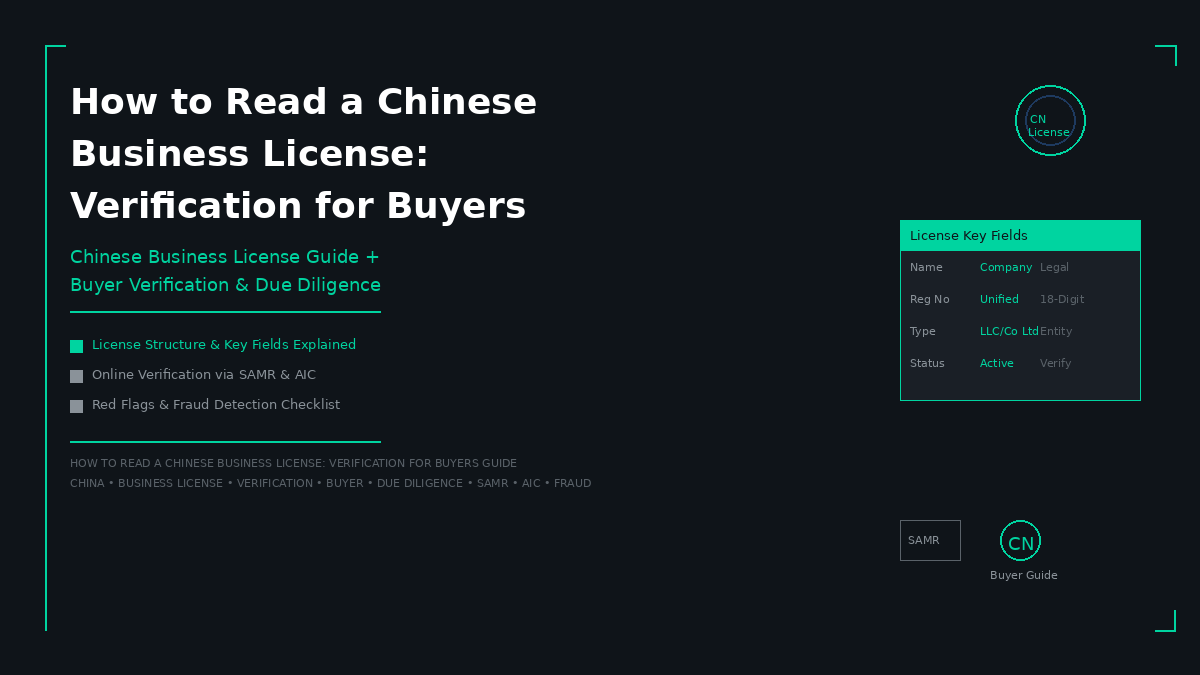
How to Read a Chinese Business License: Verification for Buyers
Quick Answer: Every Chinese business license issued after January 1, 2015 must display the 18-character Unified Social Credit Code (USCC, Unified Social Credit Code (USCC)) per GB 32100-2015 . To verify a business license, use NECIPS (National Enterprise Credit Information Publicity System, NECIPS (National Enterprise Credit Information Publicity System)) at necips.gov.cn as the gold standard; the NECIPS database contains the registration records of all 180+ million registered business entities in China and is operated by SAMR (State Administration for Market Regulation, SAMR (State Administration for Market Regulation)). The 9 fields on a Chinese business license include: company name, USCC, legal representative, registered address, registered capital, business scope, registration date, bRead more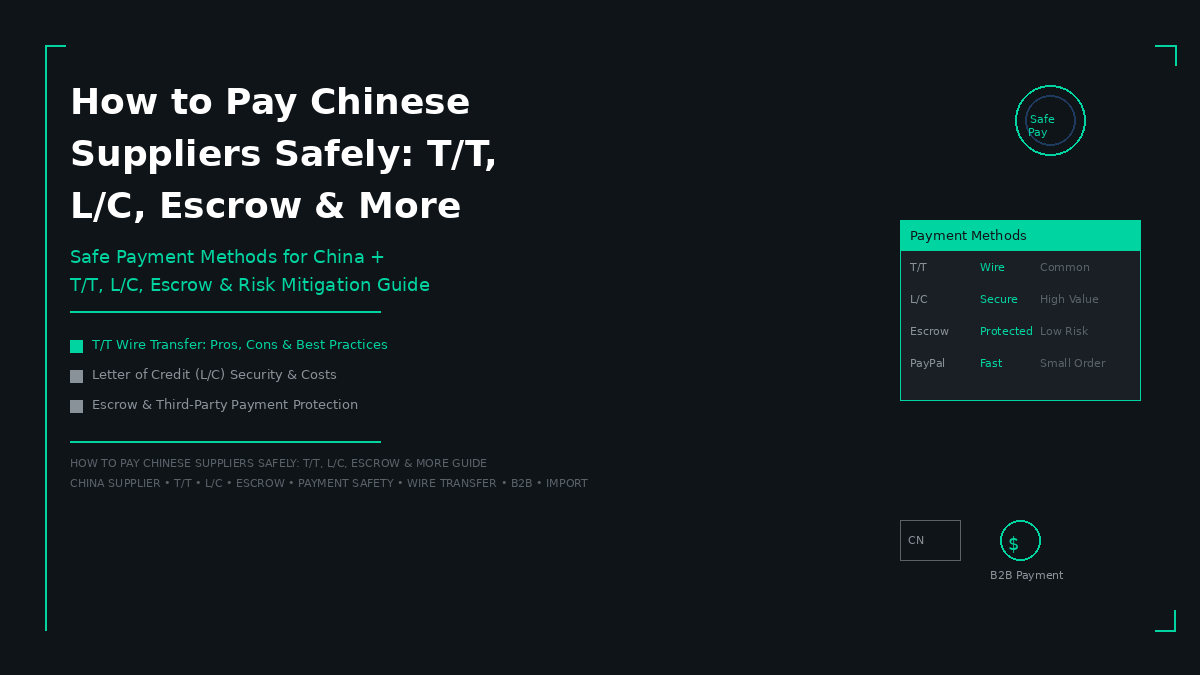
How to Pay Chinese Suppliers Safely: T/T, L/C, Escrow & More
Quick Answer: The 3 safest payment methods for first-time orders from Chinese suppliers are: (1) 30% T/T deposit + 70% T/T balance against B/L copy for orders under USD 30,000 with verified suppliers, (2) Irrevocable Sight L/C per UCP 600 Article 6 for orders above USD 50,000, (3) Alibaba Trade Assurance for orders under USD 20,000. The 3 options are ranked by buyer protection: L/C (bank-guaranteed) > Escrow (third-party) > T/T (flexible but least safe). Always verify T/T receipt via SWIFT MT103 within 24 hours of transfer. Full service china export partner from factory audit to door to door delivery integrates all 3 payment methods through our Ningbo Foreign Trade Group platform. What you will learn from this article: the 5 payment methods most commonly used in China sourcing (T/T, L/C, ERead more
Is a Sourcing Agent Worth It? ROI Math for 5 Order Sizes
Whether a sourcing agent is "worth it" depends on a single calculation: do the combined savings (price negotiation, quality dispute avoidance, MOQ reduction, payment terms) exceed the 5–10% commission? This guide walks through the break-even math, when commission pays off, and 5 order-size scenarios with detailed ROI calculations. The answer is "yes" for most orders above $30,000 — and "no" for most orders below $10,000 single-SKU. TL;DR — A sourcing agent's 5–10% commission pays off when: (1) order value is $30,000+ with multi-SKU complexity; (2) the product is custom (molds, tooling, OEM specs); (3) the buyer lacks China-side QC capability. Below $10,000 single-SKU : commission likely exceeds savings. $30,000–$150,000 multi-SKU : ROI typically 2–5x commission. Above $500,000 annual : intRead more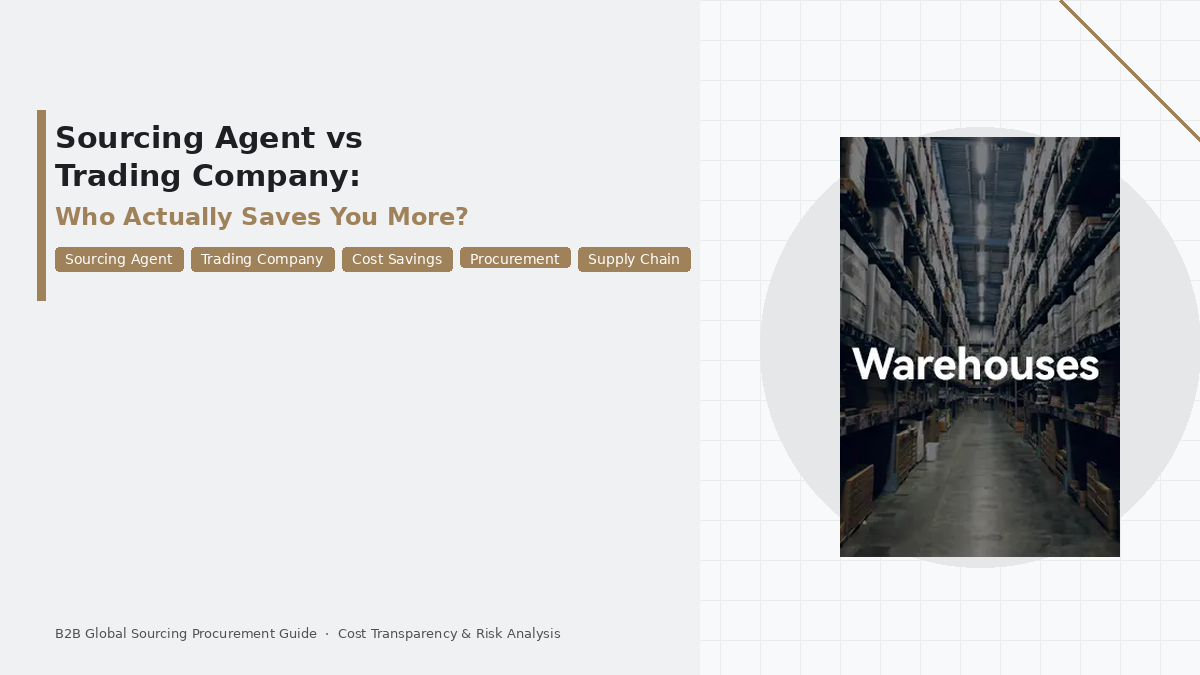
Sourcing Agent vs Trading Company: Who Actually Saves You More?
Importers comparing "sourcing agent vs trading company" often default to the wrong question. The right question is: which structure matches your order size, your operational capability, and the type of product you're sourcing? This guide walks through the structural differences, the cost mechanics, and 5 order-size scenarios where one approach wins over the other. TL;DR — A sourcing agent negotiates on your behalf and charges 5–10% commission; the buyer remains the legal importer. A trading company purchases the goods itself and resells to you at a 10–30% markup; the trading company owns the contractual relationship. Below $10,000 single-SKU → trading company often wins. $30,000–$500,000 multi-SKU → sourcing agent typically wins. Above $500,000 → direct factory + your own sourcing staff wiRead more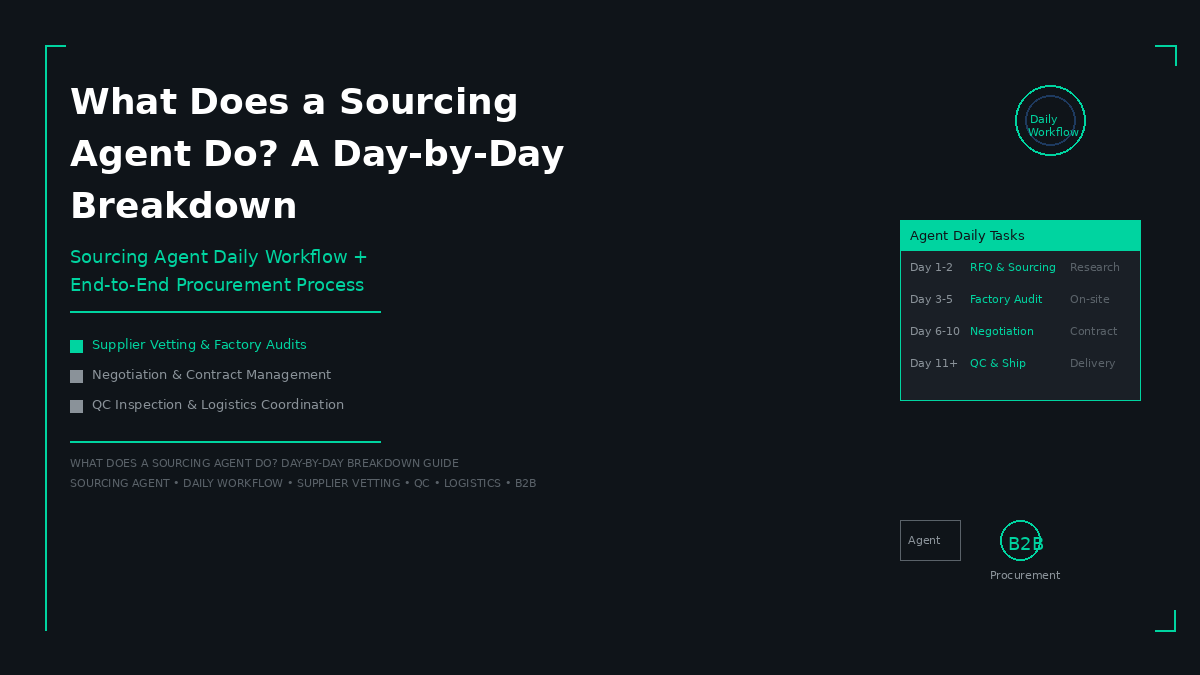
What Does a Sourcing Agent Do? A Day-by-Day Breakdown
TL;DR - Key Takeaways A sourcing agent acts as your on-the-ground representative who manages every step of procurement, from finding factories to delivering finished goods. The China sourcing agent role spans supplier identification, factory audits, sample coordination, quality inspection, logistics, and customs documentation. On a typical day, a sourcing agent handles supplier negotiations, production monitoring, quality checks, and acts as a communication bridge between international buyers and Chinese manufacturers. We at CBNB manage 36,000+ partner factories, which gives us direct access to verified production capacity across dozens of industries. You should consider hiring a sourcing agent when you need to reduce risk, save time, or lack direct relationships with Chinese factories. OuRead more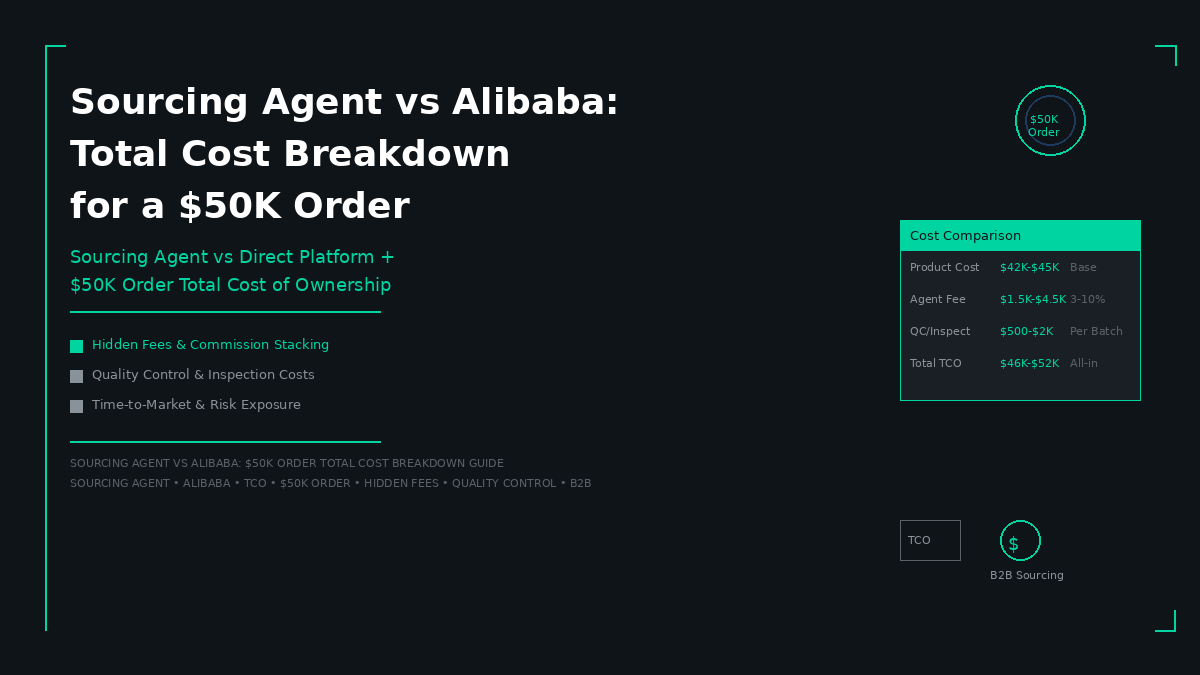
Sourcing Agent vs Alibaba: Total Cost Breakdown for a $50K Order
TL;DR Summary Product unit price is only one part of the total cost equation. When comparing sourcing agent vs Alibaba total cost, you must account for quality control, shipping consolidation, compliance, communication overhead, and hidden fees. Quality control is where the two models diverge most. Sourcing agents provide hands-on inspection at every stage, while Alibaba direct sourcing leaves quality management largely to you. Hidden costs on Alibaba can accumulate quickly -- from trade assurance fees and payment surcharges to third-party inspection and customs brokerage charges. Logistics and consolidation matter at the $50K level. A sourcing agent can combine shipments from multiple factories into optimized container loads, reducing per-unit freight costs. Risk management is the decidinRead more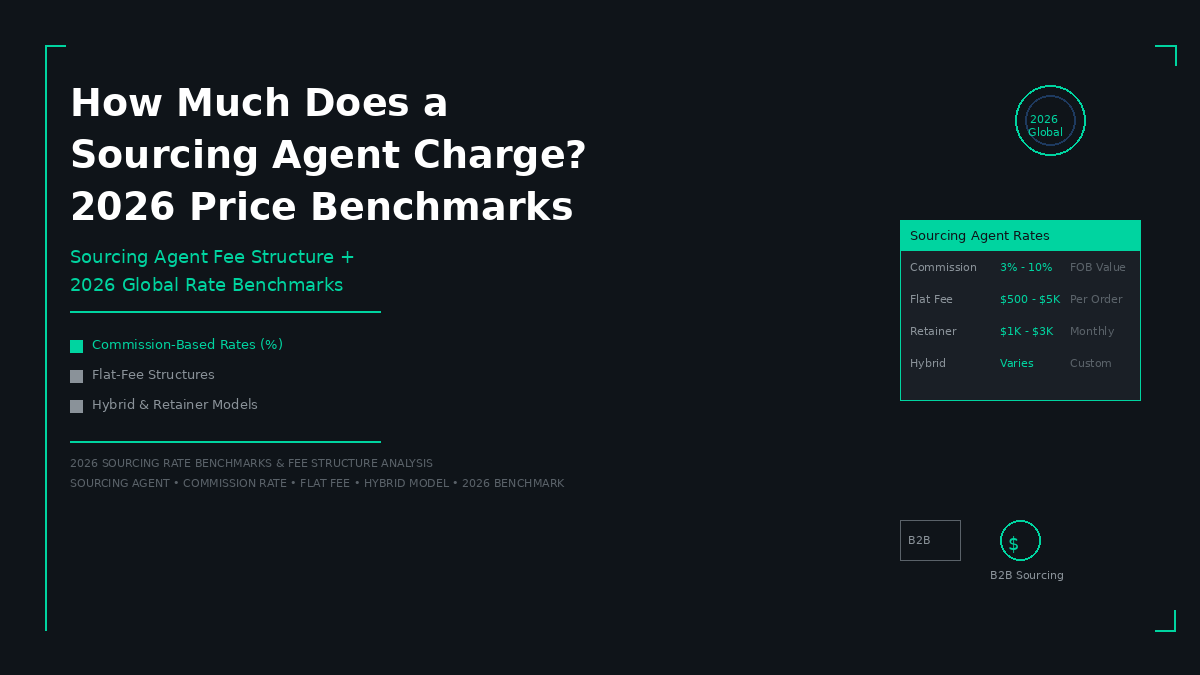
How Much Does a Sourcing Agent Charge? 2026 Price Benchmarks
TL;DR — In 2026, a China sourcing agent charges on a sliding scale across three cost bands: 5-8% all-in for entry-level orders (USD 0-50K annual FOB), 4-6% all-in for mid-volume orders (USD 250K-1M annual FOB), and 2-4% all-in for large-volume orders (USD 1M+ annual FOB). The exact rate depends on service depth (self-service, project, or full-service), SKU complexity , and geographic source region (coastal vs inland China). The article walks through the volume × service depth matrix , the decision tree for engagement model selection, the ROI calculation across the importer's team time, error avoidance, and unit price advantage, and the 2026 benchmark table for budget sizing. CBNB (CBNB Cross-Border Supply Chain). The cross-border sourcing infrastructure shown is the engagement backbone behRead more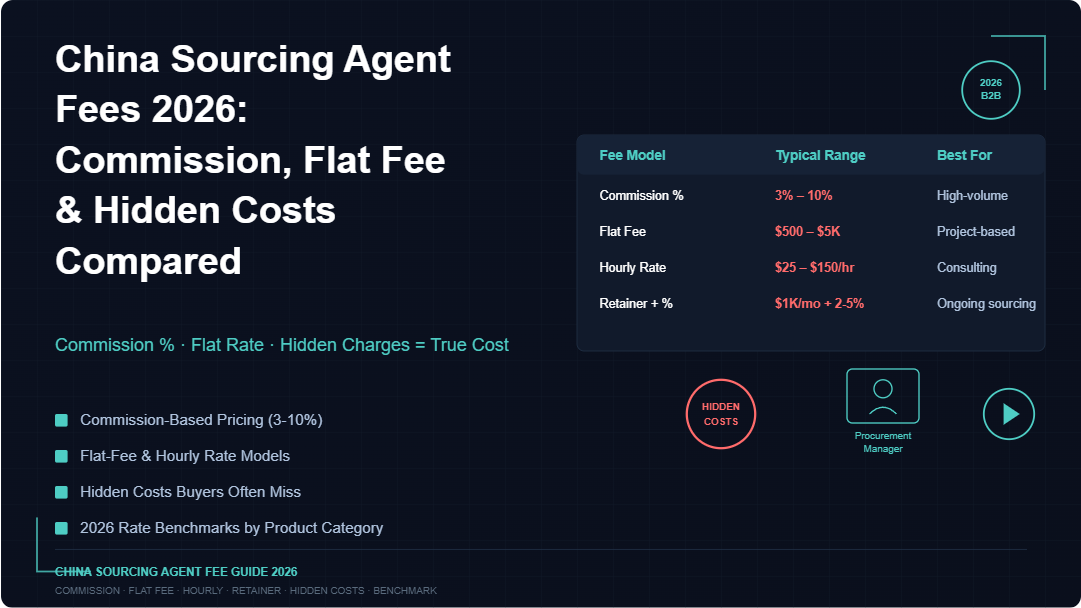
China Sourcing Agent Fees 2026: Commission, Flat Fee & Hidden Costs Compared
TL;DR — In 2026, a China sourcing agent typically charges a combination of three fee components : a percentage commission (typically 3-8% of FOB order value , midpoint 5%), a flat fee or monthly retainer (typically USD 500-3,000 per engagement), and a series of pass-through expenses (factory visit travel, samples, third-party inspection, rework handling). The right engagement model for an importer depends on the order volume band , the SKU complexity , the reorder cycle , and the in-house sourcing capacity . This article walks through the three-fee structure , the commission vs flat fee vs hybrid choice , the hidden cost line items that should be itemized in writing, and the fee type comparison matrix for import-volume-based engagement selection. Related CBNB service pages: About CBNB / CoRead more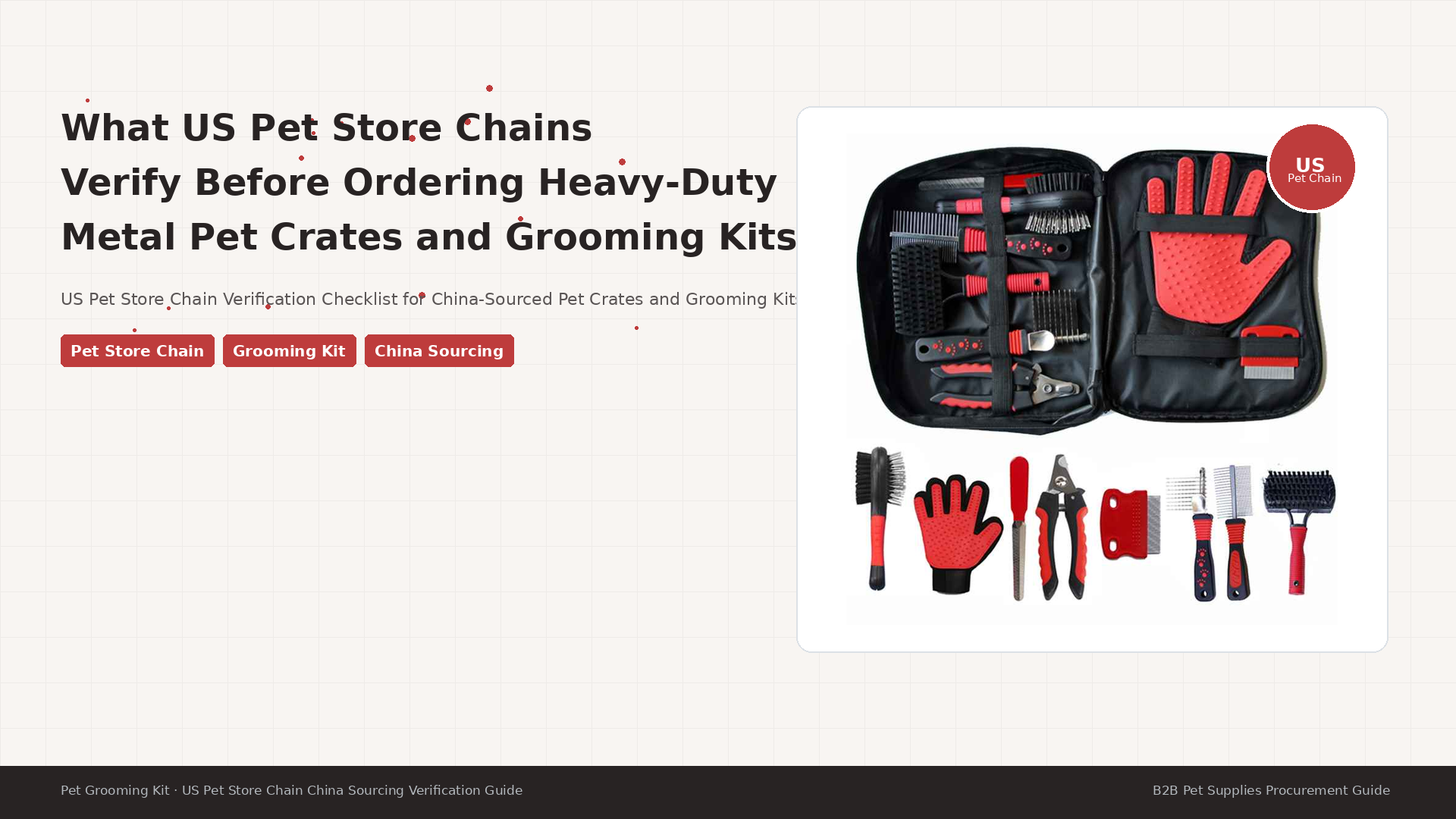
What US Pet Store Chains Verify Before Ordering Heavy-Duty Metal Pet Crates and Grooming Kits from China
TL;DR US pet chains verify weld integrity, powder-coat adhesion, and static load ratings before approving metal crate orders from China. Grooming kit imports require motor life testing, blade sharpness validation, and UL-equivalent electrical safety compliance. ASTM F963 and CPSIA documentation are non-negotiable for products sold through major US retail channels. Factory audits, packaging specifications, and UPC compliance determine whether a shipment reaches retail shelves without costly delays. Why US Pet Store Chains Source Metal Pet Crates and Grooming Kits from China I have spent three decades helping US retailers navigate international procurement, and I can tell you that the pet product category has become one of the most active segments in cross-border sourcing. The American Pet PRead more